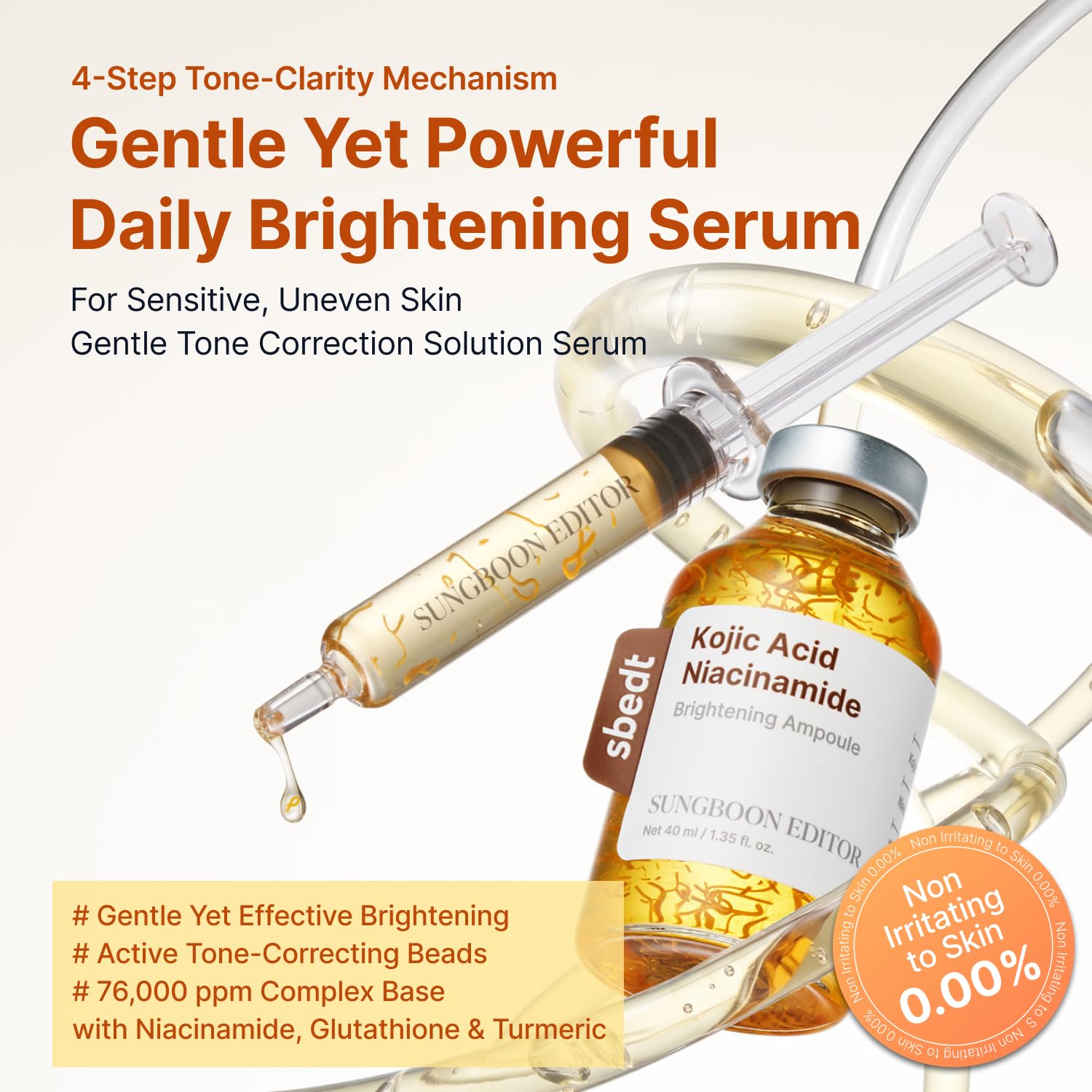
Have you ever compared two spots on your face after months of using a brightening serum — one that faded noticeably, one that stubbornly stayed — and wondered whether you were even using the right ingredient? If dark spots from old breakouts, sun exposure, or hormonal changes are the specific problem you’re trying to solve, kojic acid (a naturally derived compound originally found in fermented fungi, pronounced KOH-jik) is one of the most research-supported brightening actives you’re not fully using yet. It works by blocking tyrosinase — the enzyme your skin uses to manufacture melanin, which is the pigment that creates dark spots — and it does this without the prescription-only restrictions that come with agents like hydroquinone. This guide breaks down exactly how kojic acid works, what concentrations actually move the needle, which product formats hold up to stability scrutiny, and how to layer it without dismantling your barrier in the process.
What Kojic Acid Actually Does — and What It Doesn’t
Let’s set the table clearly, because this is where a lot of intermediate users overcorrect.
Kojic acid is a tyrosinase inhibitor. It does not bleach existing melanin that’s already been deposited in deeper skin layers; it interrupts the production of new melanin at the source. That’s a meaningful distinction for timeline management. Per the American Academy of Dermatology’s guidance on hyperpigmentation diagnosis and treatment, post-inflammatory hyperpigmentation (the brownish marks left by healed acne) and UV-induced spots both take a minimum of 8–12 weeks to show measurable fading even with optimally dosed actives — and that’s assuming consistent daily use and diligent sun protection. Realistic month-by-month expectations look more like this:
Weeks 1–4: Skin adjusts; little visible change is normal and expected. Weeks 5–8: Subtle evening of tone around the edges of existing spots. Weeks 9–16: Measurable fading of superficial (epidermal) pigmentation. Month 6+: Deeper or older spots continue gradual improvement; dermal pigmentation requires longer intervention or a professional adjunct.
If a product’s marketing promises visible results in two weeks, the math doesn’t support that claim. Kojic acid is a sustained-use ingredient, not a fast-twitch one.
Where it genuinely competes: Healthline’s overview of kojic acid notes it compares favorably to arbutin (another tyrosinase inhibitor) in head-to-head formulation studies, and some research suggests it outperforms vitamin C at equivalent concentrations for melanin inhibition — though vitamin C has the added antioxidant benefit that kojic acid lacks. It’s also more stable than ascorbic acid (the pure form of vitamin C, which oxidizes readily on contact with air and light), giving it a formulation advantage that matters in real-world use.
Concentration and Stability: Where Most Products Get It Wrong
The effective concentration window for kojic acid is 1–4%. Below 1%, evidence for efficacy is thin. Above 4%, the irritation risk climbs sharply without a corresponding bump in results — and in the EU, the Cosmetics Regulation actually caps leave-on products at 1% kojic acid as of recent regulatory guidance, which is worth knowing if you’re cross-referencing European formulations.
Paula’s Choice Expert Advice notes that kojic acid is notoriously unstable — it oxidizes and turns brown when exposed to light and air, much like ascorbic acid does. This makes packaging format a genuine buying criterion, not a cosmetic one:
| Format | Stability Score | Notes |
|---|---|---|
| Opaque airless pump | Best | Minimizes air and light exposure with every press |
| Dark glass bottle with dropper | Acceptable | Reintroduces air each use; shorter post-open life |
| Clear plastic jar | Poor | Rapid oxidation; often visible as yellowing or browning |
| Sheet mask / single-use sachet | Variable | High at point of use; no long-term stability concern |
If your kojic acid serum or cream has turned noticeably yellow or brown since you opened it, the active is largely degraded. This is not a brand-loyalty question — it’s a formulation and packaging question that applies across price points from The Ordinary to clinical-grade systems.
A note on dipotassium glycyrrhizate and kojic dipalmitate: Some formulas use kojic dipalmitate, a more stable ester form of kojic acid. It penetrates differently and the evidence base is smaller, but several cosmetic chemists writing for Cosmetics and Toiletries have flagged it as a reasonable stability workaround. The Beauty Brains has also addressed this trade-off, noting that while kojic dipalmitate is lipophilic (oil-loving, meaning it disperses better through fatty layers) and more shelf-stable, conversion to active kojic acid in skin tissue is enzyme-dependent and not guaranteed at the same rate. Understand what you’re buying.
How to Layer Kojic Acid Without Destroying Your Barrier
This is the section where intermediate users most often miscalculate — specifically by stacking kojic acid with other actives in a way that compounds irritation without compounding efficacy.
The tradeoffs, named explicitly:
Kojic acid + vitamin C: Potentially synergistic for brightening (dual-pathway melanin inhibition), but both can be mildly acidic and sensitizing. If you’re using both, consider alternating AM/PM rather than layering in the same routine. Byrdie’s roundup of kojic acid products consistently notes user reports of increased sensitivity when this combination is applied simultaneously without adequate barrier support.
Kojic acid + AHAs/BHAs (glycolic, lactic, salicylic acids): High-risk pairing for barrier compromise. Exfoliation can enhance penetration of kojic acid — which sounds good in theory but in practice often means sensitized, compromised skin that reacts rather than responds. If you’re cycling an exfoliant, use kojic acid on non-exfoliation nights or build up slowly over 4–6 weeks before combining.
Kojic acid + retinol or retinoids: This is where clinical-grade users often push too hard. Both are legitimate actives for pigmentation. Both can thin the surface layers of the stratum corneum (the outermost skin layer, your barrier’s first line of defense) over time. Dermatologist-guided protocols typically introduce them sequentially, not simultaneously. If you’re on a retinoid, a reasonable framework is: establish retinoid tolerance first (usually 8–12 weeks), then introduce kojic acid as a targeted spot treatment rather than an all-over layer.
What actually helps kojic acid work better without the downside:
- Niacinamide (vitamin B3): Complementary mechanism (it inhibits the transfer of melanosomes — the packets that carry melanin to skin cells — rather than melanin production itself). Non-irritating at 5–10%, pairs well with kojic acid, and actively supports barrier function. This is one of the few genuinely additive stacks with a clean risk profile.
- Ceramide-rich moisturizers: Kojic acid at effective concentrations (2–4%) can be mildly drying. A ceramide moisturizer applied after your kojic acid treatment maintains lipid barrier integrity and reduces the sensitization window. CeraVe’s formulations are frequently cited in aggregated consumer reviews for this exact use case at accessible price points.
- SPF, every day, non-negotiable: Tyrosinase inhibitors work by reducing new melanin production. UV exposure triggers melanin production. If you’re not using SPF 30+ daily, you’re running the engine and the brakes simultaneously. The AAD is explicit on this point in its hyperpigmentation treatment guidance.
Buying Framework: If X, Then Y
Here’s the decision logic, stated plainly.
If you’re building your first dedicated dark-spot routine on a limited budget: Look for a kojic acid serum or cream in the 1–2% range from a brand that uses opaque or airless packaging. The Ordinary’s kojic acid formulations have entered this space at an accessible price point; reviewers across aggregated beauty communities note measurable results at 12+ weeks with consistent use. Pair with an SPF and a niacinamide product. Do not stack exfoliants in the first 60 days.
If you’ve already cycled through drugstore actives and want to invest in a mid-tier formula: Prioritize formulas in the 2–4% concentration range with verified stable packaging and a supporting ingredient deck (niacinamide, ceramides, or peptides that buffer sensitization). Brands in the Paula’s Choice and Tatcha tier have documented formulation rationale — not just marketing copy — that you can cross-reference. Ask specifically whether the formula uses kojic acid or kojic dipalmitate, and what the concentration is. If a brand won’t disclose concentration, that’s a yellow flag.
If you’re in the clinical-grade or practitioner-guided segment: The conversation shifts to protocols, not just products. Kojic acid is often used as part of a multi-modal depigmentation system alongside prescription-strength retinoids, chemical peels (which increase kojic acid penetration dramatically post-procedure), and professional-grade SPF. Obagi’s Nu-Derm Fx system, for instance, incorporates tyrosinase-inhibiting agents within a structured protocol that sequences actives deliberately — the principle of which applies even if you’re building a non-Rx equivalent. If you’re at this tier, the product choice matters less than the protocol design. Work backwards from your barrier tolerance, not forwards from the highest-potency option available.
The tradeoff that applies at every tier: Higher concentration = faster results ceiling, but also faster barrier compromise ceiling. The users who get the best long-term outcomes are the ones who build slowly, maintain SPF discipline, and don’t restart from scratch every three months because irritation forced a reset. Boring, but the data pattern is consistent.
By the Numbers
- 1–4%: Effective concentration range for kojic acid in leave-on formulations (below 1% = weak evidence; above 4% = diminishing returns, higher irritation risk)
- 8–12 weeks: Minimum realistic window before measurable fading of epidermal dark spots, per AAD hyperpigmentation guidance
- 1%: EU Cosmetics Regulation cap for kojic acid in leave-on products (relevant if comparing European vs. US-market formulations)
- 5–10% niacinamide: Optimal supporting concentration when stacking for barrier-safe brightening
A Note on Patch Testing You’ve Probably Skipped
Even at intermediate level, patch testing gets deprioritized. For kojic acid specifically, contact dermatitis (a localized skin reaction distinct from general sensitivity) is a documented side effect — the Journal of Cosmetic Dermatology’s review of kojic acid’s safety profile flags this as the most common adverse reaction in clinical use. A 48-hour patch test on the inner arm before full-face application is a 10-minute investment that prevents a two-week setback. Don’t skip it, even with a formula you’ve tolerated similar actives in before.
Kojic acid is a legitimate, well-researched brightening ingredient with a meaningful evidence base — but it performs exactly as well as the protocol around it. Get the concentration right. Protect the packaging. Stack with niacinamide, not exfoliants. And give it at least three months before you judge the result. That’s the unsexy version of the answer, but it’s the accurate one.